
The Application Gallery features COMSOL Multiphysics® tutorial and demo app files pertinent to the electrical, structural, acoustics, fluid, heat, and chemical disciplines. You can use these examples as a starting point for your own simulation work by downloading the tutorial model or demo app file and its accompanying instructions.
Search for tutorials and apps relevant to your area of expertise via the Quick Search feature. Note that many of the examples featured here can also be accessed via the Application Libraries that are built into the COMSOL Multiphysics® software and available from the File menu.

In this benchmark model for blood flow in a centrifugal pump, simulations are performed for several flow rates and pump speeds. The modeled geometry is taken from the FDA’s Computational Round Robin and the results are in good agreement with the experimental data. The computed shear ... Read More
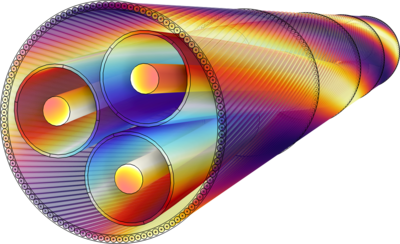
In this set of eight tutorial models and associated documentation, you can investigate the resistive, capacitive, inductive, and thermal properties of a standard three-core lead-sheathed XLPE HVAC submarine cable with twisted magnetic armor (500 mm2, 220 kV). The series includes a 2D, 2D ... Read More

During professional wine tasting, several samples of wine are judged in one session. It is important that each sample is covered, since evaporation of ethanol and water will change the taste. This model simulates the evaporation of ethanol and water from a wine glass. Evaporation of ... Read More

This model shows one approach for obtaining a broadband impulse response by combining ray-tracing and finite element methods. The combination is done all within COMSOL® and uses idealized filters. In this example, the simulation results are further compared to an analytical solution ... Read More

These models introduce how to perform convolution via the convolution integral, discrete convolution, and convolution theorem. Specifically, they show how to implement convolution by applying these methods to the low-pass filtering of a room impulse response (IR) and the auralization of ... Read More


