
The Application Gallery features COMSOL Multiphysics® tutorial and demo app files pertinent to the electrical, structural, acoustics, fluid, heat, and chemical disciplines. You can use these examples as a starting point for your own simulation work by downloading the tutorial model or demo app file and its accompanying instructions.
Search for tutorials and apps relevant to your area of expertise via the Quick Search feature. Note that many of the examples featured here can also be accessed via the Application Libraries that are built into the COMSOL Multiphysics® software and available from the File menu.

This benchmark model simulates three different heterojunction configurations under forward and reverse bias. It shows the difference in using the continuous quasi-Fermi level formulation versus the thermionic emission formulation for the charge transfer across the heterojunction. The ... Read More
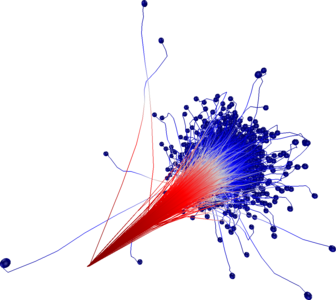
The Ion Range Benchmark model simulates the passage of energetic protons through silicon with both ionization losses and nuclear scattering. The initial energy of the protons is varied using a parametric sweep from 1 keV to 100 MeV. The average path length of the protons is compared to ... Read More

This benchmark model compares the damping coefficients of perforated plates from computation results versus experimental data. The simulation includes 18 different geometric configurations. It uses the Bao's perforation model, which is built-in in the Thin Film Flow physics interface. ... Read More

The heat exchanger in this tutorial model contains a dynamic wall with an oscillating wave shape. The deformation induces mixing in the fluid and reduces the formation of thermal boundary layers. Hence, it increases heat transfer between the walls and the fluid. In addition, the wave ... Read More

This example models cathodic protection of a steel reinforcing bar in concrete. Three different electrochemical reactions are considered on the steel surface. Charge and oxygen transport are modeled in the concrete domain, where the electrolyte conductivity and oxygen diffusivity depend ... Read More

Uncertainty quantification is used to study the effect of manufacturing variation on the performance of a 2D solidly mounted resonator (2D SMR). This tutorial shows how the resonant frequency is affected by thickness variations of the piezoelectric layer and the Bragg reflector layers. ... Read More

In this example, the High Mach Number Flow, Low Reynolds Number k-e interface is used to compute the compressible turbulent flow from a rectangular nozzle. Mesh refinement based on the estimation of the shock strength and the shear-layer strength is employed to achieve appropriate ... Read More

This model includes a dielectric slab waveguide with a small lossy metallic object nearby. The object causes light to be scattered, absorbed, and both reflected and transmitted along the waveguide. Learn more in this accompanying blog post: Modeling a Scatterer Near an Optical Waveguide Read More

In this tutorial, the acoustic properties of a wax guard are analyzed. A wax guard is a small perforated mesh used to protect the receiver (the miniature loudspeaker in a hearing aid) used for receiver-in-the-ear (RITE) or receiver-in-canal (RIC) hearing aids. Because of the very small ... Read More

This is a model of acoustic absorption by a porous acoustic open cell foam. In porous materials the sound propagates in a network of small interconnected pores. Because the dimensions of the pores are small, losses occur due to thermal conduction and viscous friction. Acoustic foams are ... Read More